The scoreboard
3.91x
Google Ads ROAS on a Florida hardware brand — $2.65M spend
We hit 92% of client goals last quarter. Schedule a call.

Industry desk
Shopify, Amazon, and DTC ads scored after COGS, shipping, and returns.
Ecommerce marketing agency for US DTC and Shopify brands that are tired of a 4x ROAS that loses money after landed cost. We run Meta, Google Ads, Amazon, TikTok, and Klaviyo as one P&L — then GEO so AI shopping answers name you first.
The scoreboard
3.91x
Google Ads ROAS on a Florida hardware brand — $2.65M spend
USA metros we work
How this desk thinks
An ecommerce marketing agency is not a media buyer with a Shopify login. It is the team that turns paid social, Google Shopping, Amazon ads, email, and the product page into net-new contribution — after COGS, shipping, discounts, payment fees, and returns. If the dashboard is green and the bank account is not, you do not have a performance problem. You have a measurement problem.
US retail ecommerce was $1.23 trillion in 2025, 16.4% of total retail sales, according to the Census Bureau. That is a huge pie and a brutal auction. Meta CPMs are still well above pre-iOS levels. Google will happily spend into one Performance Max campaign that cannibalizes brand search. Amazon will take the sale and the tax. The brands that keep growing treat MER, new-customer CAC, and payback as the scoreboard — not Facebook’s attributed ROAS.
SpikeROAS is the ecommerce marketing agency for operators who already have product-market fit and a catalog that can absorb spend. Typical desk: physical products on Shopify or Shopify Plus, often with Amazon in parallel, enough media that wasted dollars actually hurt. We do not babysit a $3k/month Advantage+ experiment. We do not redesign your theme for sport. We scale what the unit economics can carry, and we kill what they cannot.
Related: performance marketing, paid search, paid social, Amazon advertising, Shopify development, Shopify Plus development, email and lifecycle, and hardware Google Ads work. Adjacent desks: B2B SaaS, hospitality and franchise.
SpikeROAS is an ecommerce marketing agency for Shopify and DTC brands. We run Meta, Google Ads, Amazon, and Klaviyo as one P&L scored to contribution, MER, and POAS — not Ads Manager ROAS. Named proof: 3.91x Google Ads ROAS on $2.65M for a Florida hardware brand.
Fit
Shopify and DTC operators who already have product-market fit and a catalog that can absorb spend — and who are tired of a 4x ROAS that loses money after landed cost.
Physical products on Shopify or Shopify Plus, enough media that wasted dollars actually hurt. A Shopify marketing agency should protect contribution margin — not babysit a $3k Advantage+ experiment.
Hardware, lighting, outdoor, and other SKU-heavy catalogs. We run Amazon advertising next to the DTC site so TACoS and Shopify MER stop lying about each other.
Meta, Google Shopping, ecommerce PPC, Klaviyo, and CRO on one P&L. If you only need a theme rebuild, start with Shopify development. If you need pipeline after contribution, start here.
The leak
The desk
What you get
The fork
If you are comparing ecommerce marketing agencies, start here. In-platform ROAS is cheaper to report and more expensive to believe.
Angles
Blended ROAS, a tired UGC ad, and a dirty product feed are three different leaks. We sell the fix that matches the hole — not a generic 'scale Meta' retainer.
Blended ROAS hides a hole. Returning buyers and branded search inflate the number while prospecting quietly dies. We split new vs returning, pass the right conversion values, and only scale Meta or Shopping when payback on a first order (or a first-plus-90-day LTV) clears your hurdle. That is the ecommerce lead-generation problem: you are acquiring customers, not harvesting a dashboard.
DTC accounts almost never stall because nobody found the right lookalike. They stall because the same three ads fatigued and CPMs went up. We run a weekly hook / offer / format matrix — UGC, static, motion, catalog — and we retire losers on a kill rule. If your last agency sent a monthly creative 'refresh' of headline swaps, that is why CAC crawled.
Shopping and Performance Max do not forgive a dirty catalog. Titles, GTINs, custom labels by margin tier, and exclusions so a 12% margin accessory does not bid like a 55% hero SKU. We rebuild Merchant Center before we 'optimize tROAS.' Google cannot protect profit it cannot see.
A sale on Amazon that would have happened on your site at a better margin is not growth. We map TACoS, fees, and halo against Shopify MER so the two floors stop lying about each other. Brand defense on Amazon, conquest where the SKU math holds, and a rule for when a listing is a media channel vs a tax.
Black Friday creative, feed, and stock have to be in market before the auction gets stupid. We pace to contribution and sell-through, not to a vanity revenue target that clears the warehouse at a loss. If you are booked on inventory, we throttle prospecting and harvest brand. Always-on 'scale' into a stockout is how you buy one-star reviews.
Healthy US ecommerce brands often need email and SMS to carry a real share of revenue so Meta is not the only way an order happens. Welcome, abandon, post-purchase, and win-back are media. We treat them with the same kill rules as ads. That is how you survive a CPM spike without pausing the company.
Channels
US shoppers still buy on Google, Instagram, Amazon, and email. An ecommerce marketing agency that only runs one of those will blame the others when MER stalls.
Advantage+ and prospecting with a creative factory underneath. Catalog ads when the assortment is clean. CAPI and event match quality so the algorithm is not guessing after ATT. We scale what MER and new-customer CAC allow — not what Ads Manager attributes to itself.
Brand Search protected. Standard Shopping on margin-critical SKUs. PMax for volume with asset groups and listing exclusions so it cannot eat the rest of the account. Query and search-term hygiene still exists even when Google would rather you not look.
Sponsored Products, Brands, and Display against true profit after referral fees — not vanity ACOS. We will not grow Amazon share by donating DTC margin. Walmart Connect when the SKU and fee table justify a second floor.
Demand when the product is visual and the creative engine can feed it. Short-form is a test lab for Meta hooks, not a brand film budget. YouTube when consideration is real and search is ready to catch the spike.
Flows first, campaigns second. Abandon and post-purchase pay the bills. Segmentation that does not spam the list to death. SMS is a scalpel. If lifecycle is under-built, every extra dollar of paid is more expensive than it should be.
Message-match from ad to PDP. Proof, shipping, returns, and offer on the money pages. We test in revenue order — not button color. A 20% conversion lift is often cheaper than another 20% of media.
Engagement
01
Margins by SKU or collection, return rate, contribution after ads, payback, inventory, and the number that has to move. If a 3x platform ROAS still loses money, we say so before we touch bids.
02
CAPI, Enhanced Conversions, feed labels, UTM and Shopify source hygiene. Profit-shaped values into Google and Meta so Smart Bidding is not optimizing toward a lie.
03
Account structure, brand vs non-brand, Shopping vs PMax, catalog vs prospecting, and a 30-day creative slate. Ads do not launch into a PDP that contradicts the hook.
04
Weekly reallocation. Kill, hold, or scale. Q4 rules written before the auction panics. Lifecycle and CRO running so you are not buying the same customer twice.
Playbook
Facebook will report a ROAS that would make a founder hire a second warehouse. Subtract landed cost, shipping, discounts, and returns and the picture changes. We bid and budget off contribution and blended MER, and we will not scale a hero SKU that looks efficient in-platform and dies in Shopify. That is what a performance ecommerce marketing agency is for.
PMax is a volume engine. It is not a strategy. Industry reporting on Triple Whale's 2025 ecommerce panel put Search around 5.2x ROAS and PMax around 2.6x — different jobs, not a replacement. We run Shopping for control, PMax for reach, and brand Search so Google cannot charge you for your own name. Listing-group exclusions keep them from eating each other.
On DK Hardware (Florida) a messy catalog made scale impossible until Meta catalog structure was rebuilt — 10x catalog ROAS, with Google Shopping sitting underneath. Hardware, lighting, outdoor, and other SKU-heavy US catalogs usually die in feed and creative pairing, not in 'audience strategy.' We fix the catalog motion first.
Buyers ask ChatGPT, Gemini, and Google AI Overviews which brand to buy. If you are not cited, you are not on the shortlist — and your branded search gets more expensive. We run GEO next to classic ecommerce SEO: entity-clean pages, comparison content, and product facts models can quote. Paid still fills the gap this month.
Most shops run paid, or email, or Shopify builds. Founders then hire four of them. We would rather own Meta, Google, Amazon, lifecycle, and CRO together so a landing-page leak cannot be blamed on 'the ads people.' If a channel cannot earn its keep, we cut it. You will hear that in week one, not in a Q4 autopsy.
Stack
Performance Marketing
Full-funnel paid that scales only when unit economics hold.
Paid Search
Google and Microsoft Ads treated as capital — every query has a job.
Paid Social
Meta, LinkedIn, TikTok, and YouTube — creative as the media plan.
Amazon Advertising
Sponsored ads and DSP scored to profit after fees — not vanity ACOS.
Shopify Development
Shopify development agency for custom themes, store builds, and migrations that convert.
Shopify Plus Development
Shopify Plus development agency for Checkout Extensibility, Functions, B2B, and Scripts-to-Functions rebuilds.
Email & Lifecycle
Flows that pay for the second order — so paid is not the only lever.
Conversion Rate Optimization
Make the traffic you already bought pay rent.
Performance Creative
Ads designed to be tested, killed, and scaled — not presented.
Client result · Florida
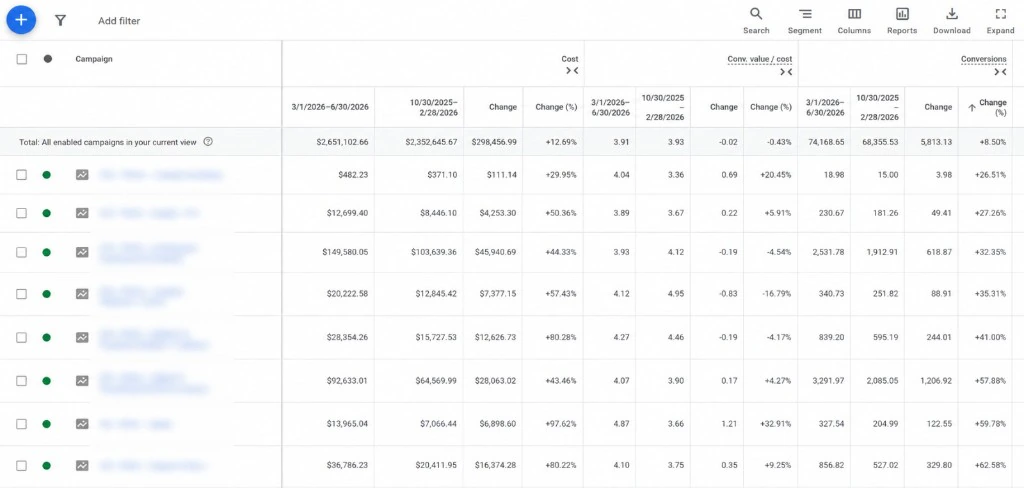
A Florida hardware brand needed Google to take more volume without breaking the unit. We rebuilt Shopping and search architecture, then scaled only where ROAS held. Mar–Jun 2026 vs the prior four months: $2.65M spend (+12.69%), 74,169 conversions (+8.50%), ROAS 3.91 vs 3.93. Catalog work on Meta still sits beside it — Google is the scale floor.
Google Ads ROAS
3.91x
held vs 3.93
Ad spend
$2.65M
+12.69%
Conversions
74,169
+8.50%
FAQ
An ecommerce marketing agency runs the demand side of an online store: paid social, Google Shopping and Search, Amazon ads, email and SMS, SEO, and conversion work. SpikeROAS ties those channels to contribution margin and new-customer CAC — not to platform ROAS that ignores COGS and returns.
Shopify and Shopify Plus are the default US stack we see, and we run Merchant Center, CAPI, and Klaviyo against that data. We also run Amazon, BigCommerce, and custom checkouts. We care about the P&L, not the theme. If you need a replatform, that is a different brief than performance.
Blended MER, contribution after landed cost, new-customer CAC, and payback. We still watch in-platform numbers because the auctions do. We do not let them run the company. Profit-shaped conversion values, Shopify as source of truth, and incrementality when spend is large enough to hold out.
Yes. Amazon is a US media channel with fees, not a side hustle. We watch TACoS next to site MER so one floor does not steal from the other. If a SKU only works on Amazon after ads and referral, we say so instead of celebrating ACOS.
Yes. Most DTC accounts die in creative, not in bid strategy. Static, motion, UGC, and catalog — scored weekly. Winners get budget. Losers leave the account. We do not present a quarterly moodboard while the same three ads keep spending.
Enough that tests can complete. If wasted media does not hurt yet, you may not need us. Site-wide we typically sit with brands already in the range where a real media budget and a senior desk make sense — often $20k+ a month across paid and organic. We will tell you on the call if the math is too thin.
Both, with jobs. Shopping for margin-critical SKUs and query control. PMax for volume across Google surfaces once conversion density can feed it. Brand Search stays separate so PMax cannot harvest your name and call it prospecting. Google's own help files still describe PMax as a complement to Search, not a replacement.
Yes — collection architecture, product and category pages, technical hygiene, and GEO. Organic is how you stop renting every session. Ads still fill the calendar while SEO compounds.
Paid can produce orders in days once tracking, feed, and the offer are honest. A stable MER usually takes 3–6 weeks of creative and structure tests. Lifecycle and SEO take a quarter to show up as a real share of revenue. We do not wait 90 days to start killing waste.
Pre-revenue stores, pure dropship lottery catalogs, and brands that want a logo farm or a percentage-of-spend shop that is paid to spend more. If you need a theme rebuild more than a P&L, start with a Shopify partner. If you need pipeline after contribution, start here.
Also on the floor
Further reading
Next step
Tell us MER, new-customer CAC, and the SKU mix. We will map Meta, Google Shopping, Amazon, and Klaviyo to contribution — and what we would cut.