
A patient in Jaipur searches “best ENT doctor near me” on Google. Three clinics show up. One has clear fees, 200+ reviews, and online booking. The other two have no website.
Guess who gets the appointment?
This is the marketing mix in healthcare at work. Not billboards. Not TV ads. A simple system that decides whether patients find you, trust you, and choose you.
India’s healthcare market hit $638 billion in 2025. It is racing towards $1.5 trillion by 2030. Over 11,000 healthtech startups are fighting for patient attention. And 73% of urban Indian patients now research hospitals online before they ever walk in.
The clinics winning this race are not the ones spending the most. They are the ones with a sharp, well-executed marketing mix.
This guide breaks down exactly how the 7 Ps of healthcare marketing work for Indian clinics and hospitals. You will get real examples from Apollo, Fortis, Pristyn Care, and Practo. You will get action checklists for each P. And you will get a self-audit scorecard you can use today.
No theory. No jargon. Just what works.
What Exactly Is the Marketing Mix in Healthcare?
The marketing mix is a planning framework that helps you decide how to attract patients, deliver care, and build loyalty. It answers one question: “Are we doing the right things, at the right price, in the right place, with the right people?”
In product-based businesses, the classic 4 Ps (Product, Price, Place, Promotion) are enough. But healthcare is a service. The experience matters as much as the treatment. So we use the extended 7 Ps model.
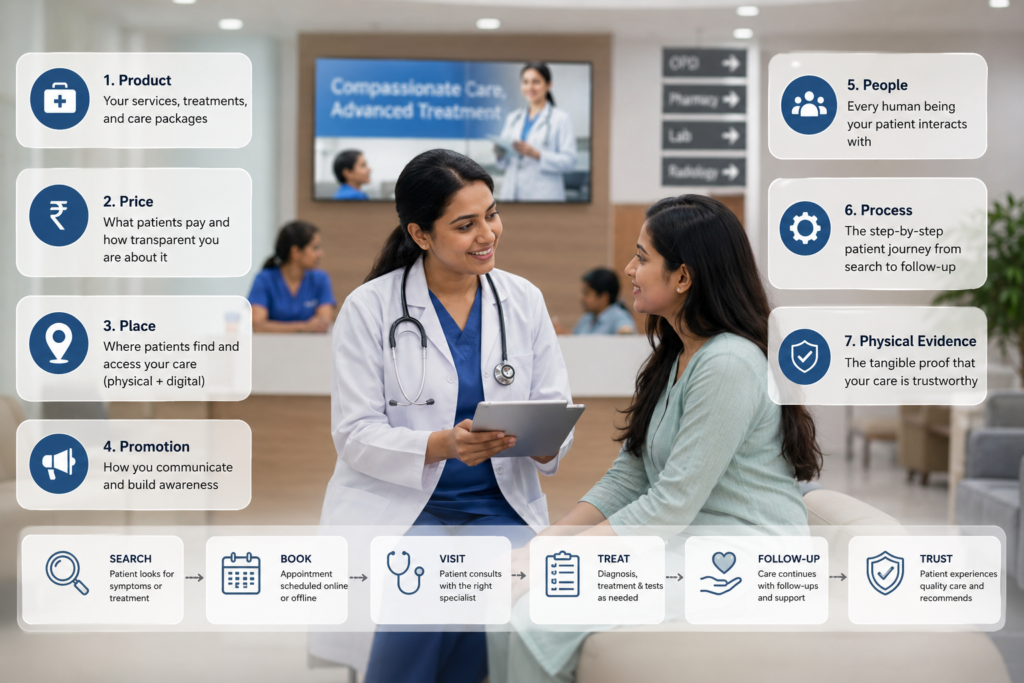
The 7 Ps of Healthcare Marketing:
- Product — Your services, treatments, and care packages
- Price — What patients pay and how transparent you are about it
- Place — Where patients find and access your care (physical + digital)
- Promotion — How you communicate and build awareness
- People — Every human being your patient interacts with
- Process — The step-by-step patient journey from search to follow-up
- Physical Evidence — The tangible proof that your care is trustworthy
Think of these 7 Ps as the gears inside a clock. Each one turns the next. If even one gear is stuck, the whole clock stops.
Why this matters more than you think: A 2025 study in the International Journal of Healthcare Information Systems and Informatics tested all 7 Ps against patient satisfaction. The result? Process and People were the dominant factors. Process made patients 24x more likely to rate a hospital positively. People had an 8.6x impact. Not price. Not promotion. The experience itself.
For Indian clinics competing against well-funded hospital chains, this is powerful news. You do not need the biggest budget. You need the best system.
Why the 7 Ps Are Non-Negotiable for Indian Healthcare in 2026
India’s healthcare landscape has shifted dramatically. Here is what you are competing against right now:
The numbers that matter:
- India’s healthcare sector is projected to grow at 18-20% CAGR through 2030
- The digital health market alone is expected to reach $106 billion by 2033
- Over 35 crore Ayushman Bharat health cards have been issued, making cashless treatment mainstream
- 50% of new diagnostic chain launches in 2023-24 happened in Tier 2 and Tier 3 cities
- India’s hospital market was valued at $98.98 billion in 2023, growing at 8% CAGR
- The single-specialty provider market will triple from $4.4 billion to $12.3 billion by 2030
- The telemedicine market is expected to reach ₹47,130 crore ($5.4 billion) by 2025
What this means for your clinic:
The old approach — put up a signboard, rely on word-of-mouth, and wait — no longer works. Patients today compare hospitals on Google. They check reviews on Practo. They look at your Instagram before booking. They expect online booking, transparent pricing, and WhatsApp communication.
If your marketing mix has gaps, patients will find a competitor who filled those gaps. Even if your clinical care is superior.
The 7 Ps of Healthcare Marketing — Deep Dive for Indian Clinics & Hospitals
P1: Product — You Are Not Selling Treatments. You Are Selling Outcomes.
Most clinics think their product is the consultation or the surgery. It is not. Your product is the complete outcome a patient experiences — from the moment they feel a symptom to the day they feel fully recovered.
What makes up your “product” in healthcare:
- OPD consultations (general + specialist)
- Diagnostic services (pathology, radiology, imaging)
- Surgical and interventional procedures
- Preventive health check-up packages
- Telemedicine and video consultations
- Wellness services (nutrition, physiotherapy, mental health)
- Post-treatment follow-up and chronic disease management
- Emergency and ambulance services
How leading Indian healthcare brands design their product:
Apollo Hospitals does not just run hospitals. They built Apollo 24|7 — a digital health platform combining online doctor consultations, diagnostic bookings, digital health records, and an online pharmacy. They bundled primary care, specialty care, diagnostics, and pharmacy into one ecosystem. The patient never has to leave the Apollo world.
Pristyn Care identified that elective surgeries (piles, hernia, gallstones, kidney stones) had a broken patient experience in India. Unclear pricing. Long waits. No post-surgery support. So they designed a product around fixing that experience. Every patient gets a dedicated “Care Buddy” who handles everything from insurance paperwork to post-op follow-ups. They do not own hospitals. They partner with 700+ hospitals and focus entirely on owning the patient experience.
Thyrocare took a completely different route. They focused on one thing — affordable, bundled diagnostic test packages. A full-body check-up for ₹999 when others charged ₹5,000+. They made diagnostics accessible to middle-income India.
What you should do — Product Action Checklist:
- [ ] List every service your clinic offers. Identify gaps patients keep asking about.
- [ ] Create at least 3 bundled health packages (e.g., “Complete Cardiac Check — ₹1,999” or “Women’s Wellness Package — ₹1,499”).
- [ ] Add telemedicine. Even a 10-doctor clinic can offer scheduled WhatsApp video consultations.
- [ ] Build a post-treatment follow-up protocol. Call every patient 48 hours after discharge or procedure.
- [ ] Identify one specialty you can “own” in your city. Become known for it.
P2: Price — The One Thing Indian Patients Hate Most Is Surprise Bills
India has one of the highest out-of-pocket healthcare expenditure rates among major economies. Patients are not just price-sensitive — they are trust-sensitive about pricing. A surprise bill destroys loyalty faster than a bad diagnosis.
India’s pricing reality:
- Ayushman Bharat covers treatments up to ₹5 lakh per family per year for eligible families
- Standalone health insurers captured 41% of the non-life insurance market by FY25
- Campaigns promoting “cashless facility” or “easy EMI” consistently outperform those focused only on clinical expertise
- In Tier 2 and 3 cities, patients regularly compare costs across 3-4 hospitals before deciding
Pricing strategies that work in Indian healthcare:
Transparent display pricing. Put your consultation fees, procedure costs, and package rates on your website and Google Business Profile. When patients cannot find your fees, they assume you are expensive. Transparency is a competitive advantage.
Bundled packages. Combine consultation + diagnostics + follow-up into a single price. Patients love knowing the total cost upfront. Thyrocare’s entire business model proves this works.
Tiered pricing. Offer different room categories — general ward, semi-private, private, deluxe — at different price points. Same clinical care, different comfort levels. This lets patients choose based on their budget without feeling judged.
EMI and financing options. Partner with healthcare lending platforms like Bajaj Finserv Health EMI, Simpl, or LazyPay. No-cost EMIs on surgeries and major treatments remove the biggest barrier to treatment decisions.
Government scheme integration. Get empanelled under Ayushman Bharat (PM-JAY) and your state’s health insurance scheme. This opens up a massive patient base that was previously locked out.
Insurance TPA partnerships. Display “Cashless Insurance Available” prominently everywhere — website, reception, signage. For many patients, this single factor decides which hospital they choose.
What you should do — Price Action Checklist:
- [ ] Display consultation fees on your website, Google Business Profile, and Practo listing. Today.
- [ ] Create at least 3 health check-up packages at ₹999, ₹1,999, and ₹3,999 price points.
- [ ] Display “Cashless Insurance Accepted” on your homepage, reception area, and all digital profiles.
- [ ] Train front desk staff to explain costs clearly before any procedure — no surprises.
- [ ] Explore EMI partnerships for procedures above ₹10,000.
- [ ] Get empanelled under Ayushman Bharat if you have not already.
P3: Place — Be Findable Where Your Patients Actually Look
“Place” in healthcare has two layers. Your physical location. And your digital presence. In 2026, the digital layer often matters more.
Physical location still counts:
- Is your clinic on a main road with clear, visible signage?
- Is there parking? (This is a massive pain point in Indian cities.)
- Can patients reach you by auto, bus, or metro?
- Is the approach road well-lit for evening OPD?
Fortis Healthcare strategically places hospitals in urban and suburban areas with high population density. They also open smaller affiliated clinics and diagnostic centres in different neighbourhoods to extend reach without building new hospitals.
But digital place is where you win or lose patients:
Google Business Profile (GBP) — This is your single most important digital asset. When a patient in Mumbai searches “best dermatologist near me,” Google shows the local map pack first. If you are not on GBP with complete information, photos, hours, and reviews, you are invisible.
Practo, Lybrate, and healthcare directories — Over 30 crore patients have used Practo. Over 1 lakh verified doctors are listed. If you are not on Practo, those patients will never find you.
Your website — It must load in under 3 seconds on mobile. Most Indian patients browse healthcare on their phones. A slow, desktop-only website bleeds patients.
WhatsApp Business — In Tier 2 and 3 cities, WhatsApp is the primary booking channel. Diagnostic chains report up to 2x return on investment when they pair local advertising with WhatsApp-based appointment scheduling.
Google Maps optimization — Add your clinic to Google Maps with accurate pin, photos of the exterior (so patients can find you), and directions from major landmarks.
What you should do — Place Action Checklist:
- [ ] Claim and fully optimize your Google Business Profile — add 10+ real photos, all services, hours, phone number, and website link.
- [ ] List your practice on Practo and Lybrate with complete details.
- [ ] Test your website on mobile. If it takes more than 3 seconds to load, fix it.
- [ ] Set up WhatsApp Business with automated greeting and appointment booking.
- [ ] Add your clinic to Google Maps with an accurate pin and exterior photos.
- [ ] For Tier 2/3 clinics: add your clinic to JustDial and local healthcare directories too.
P4: Promotion — Educate. Do Not Advertise. That Is the Rule.
Healthcare promotion in India is one of the most regulated spaces in the world. Understanding what you CAN and CANNOT do is not optional — it is survival.
What Indian law says you CANNOT do:
- Doctors cannot directly solicit patients or highlight their personal achievements in ads (NMC Ethics Regulations, 2002)
- No patient testimonials, before/after photos, or case details on your own website or social media (NMC Social Media Guidelines, 2023)
- No claims of “guaranteed cure,” “best results,” “100% success rate,” or “permanent solution”
- Terms like “best,” “guaranteed,” or “instant results” can trigger ASCI penalties and even Supreme Court scrutiny
- The Drugs and Magic Remedies Act 1954 prohibits advertising cures for 54 listed conditions including diabetes, hypertension, cancer, and sexual health
- The Digital Personal Data Protection Act (DPDP) 2023 restricts using patient health data for targeted ads or remarketing
- Google now requires pre-verification for healthcare advertisers in India
What you CAN do — and should:
Educational content marketing. Write blog posts about symptoms, prevention, treatment options, and health awareness. “How to Manage Diabetes” is perfectly compliant. “Cure Diabetes in 30 Days” is illegal. This is the safest and most effective long-term strategy.
SEO (Search Engine Optimisation). Rank for search terms patients actually type — “knee replacement cost in Bangalore,” “best cardiologist in Pune,” “PCOS treatment in Delhi.” This brings high-intent patients directly to your website.
Google Ads for procedures and specialties. You can run ads for your hospital’s specialties and procedures. You cannot run ads promoting individual doctors. Google requires LegitScript certification for certain categories like addiction treatment.
Social media health tips. Post health awareness content, seasonal health advice, and educational infographics on Instagram and Facebook. Three times a week is a good starting frequency.
Local community outreach. Conduct free health camps, sponsor local events, participate in Rotary/Lions Club health drives. This builds trust in your immediate catchment area faster than any digital ad.
YouTube educational videos. Create short videos explaining conditions and procedures. No patient details. No outcome claims. Just clear, helpful information.
How Pristyn Care nailed ethical promotion:
They invested heavily in Google Search ads targeting patients searching for specific surgeries. They created regional language content and localised campaigns for Tier 2 and 3 cities. Their YouTube channel demystified surgical procedures with educational content — reducing patient fear without making outcome claims. Result: unicorn valuation.
What you should do — Promotion Action Checklist:
- [ ] Start a blog. Publish 2 educational articles per month on your website.
- [ ] Run Google Ads for your top 3 procedures or specialties.
- [ ] Post health tips on Instagram 3x per week. Use local language when possible.
- [ ] Conduct one free health camp per quarter in your locality.
- [ ] Create 1 educational YouTube video per month.
- [ ] Never make outcome claims. Educate. Inform. Let the patient decide.
- [ ] Review all your marketing material against NMC and ASCI guidelines. Remove anything non-compliant.
P5: People — Your Receptionist Has More Marketing Power Than Your Billboard
This is the most underrated P. And the most powerful one.
Patients do not remember your hospital’s tagline. They remember how the receptionist greeted them. Whether the nurse was gentle. Whether the doctor listened for more than 3 minutes. Whether the billing person explained the charges patiently.
A 2025 hospital marketing study found that positive staff interactions made patients 8.6 times more likely to view the hospital positively. That is not a small number. That is the difference between a 3-star and a 5-star Google review.
Every person counts:
- Doctors and specialists
- Nurses and ward staff
- Receptionists and front desk executives
- Billing and insurance desk staff
- Lab technicians and diagnostic staff
- Security guards and housekeeping
- Ambulance drivers
- Your social media manager and call centre team
Each one of these people is your brand. Patients judge the entire hospital based on the weakest interaction they have.
What top Indian hospitals do with their “People” strategy:
Apollo invests in continuous training for both clinical and non-clinical staff. Fortis enforces dress codes, professionalism standards, and empathy protocols across all facilities. Pristyn Care assigns a dedicated “Care Buddy” to every patient — a non-clinical person whose only job is to make the patient feel supported.
What you should do — People Action Checklist:
- [ ] Train front desk staff on empathetic communication. Script the first 30 seconds of every patient interaction.
- [ ] Create a simple dress code and grooming standard for all staff.
- [ ] Hire for attitude. Train for skill. A kind receptionist matters more than a fast one.
- [ ] Run monthly 30-minute “patient experience” training sessions.
- [ ] Ensure doctors spend at least 8-10 minutes per consultation. Rushed consultations destroy trust.
- [ ] Ask patients: “How was your experience with our staff today?” Track the answers.
- [ ] Recognise and reward staff who get positive patient feedback.
P6: Process — The Silent Killer of Patient Satisfaction
If a patient waits 90 minutes in your OPD with no update, it does not matter how good the doctor is. The experience is already ruined.
Process is the entire patient journey. From the first Google search to the follow-up call after treatment. Research consistently shows it is the single strongest predictor of patient satisfaction — more than price, more than promotion, more than physical evidence.
The 10-step patient process:
- Discovery — Patient searches online or gets a referral
- First contact — Calls, sends a WhatsApp message, or walks in
- Registration — Fills forms, provides ID and insurance details
- Waiting — Sits in OPD queue
- Consultation — Meets the doctor
- Diagnostics — Gets tests done (if needed)
- Treatment — Receives medication, procedure, or surgery
- Billing — Pays the bill, processes insurance claim
- Discharge — Leaves the hospital
- Follow-up — Gets a call, books a review appointment
Where Indian clinics commonly fail:
- Long, paper-heavy registration processes with the same information asked multiple times
- Unpredictable wait times with zero communication to the patient
- Billing surprises after treatment is complete
- No digital booking — everything is walk-in only, first-come-first-served
- Zero follow-up after discharge. The relationship ends at the billing counter.
- Insurance claim confusion — patients left to chase TPAs themselves
Where they get it right:
Apollo Hospitals has built integrated digital systems covering the entire journey from appointment to discharge to follow-up. Practo helps hospitals digitise discovery, booking, consultations, and medical records — connecting the entire ecosystem. Pristyn Care’s end-to-end digital process means a patient can go from diagnosis to surgery to recovery with every step managed through their app.
What you should do — Process Action Checklist:
- [ ] Enable online appointment booking on your website, Google Business Profile, and WhatsApp.
- [ ] Send automated SMS or WhatsApp confirmations with appointment time and expected wait.
- [ ] Display estimated wait times in the waiting area. Update them every 30 minutes.
- [ ] Digitise billing. Give patients a clear, itemised cost breakdown before they pay.
- [ ] Call every patient 48 hours after discharge for a follow-up check.
- [ ] Use a 3-question patient feedback form after every visit. Track scores monthly.
- [ ] Map your entire patient journey on paper. Find the step with the most complaints. Fix that one first.
P7: Physical Evidence — Patients Judge Your Competence by Your Washroom
It sounds harsh. But it is true. Studies confirm that patients often equate modern, clean infrastructure with better care quality — even when the clinical quality is identical. In healthcare, what patients see shapes what they believe.
Physical evidence includes:
- Cleanliness of the facility (floors, washrooms, corridors, consultation rooms)
- Signage and wayfinding (can patients find the right department without asking 3 people?)
- Waiting area comfort (seating, ventilation, drinking water, mobile charging points)
- Equipment appearance (does it look modern or like it belongs in a 1990s film?)
- Staff uniforms and grooming
- Certificates, accreditations, and doctor qualifications on display
- Brochures, pamphlets, and health education materials
- Your website design and quality of photos
- Google review ratings and Practo profile completeness
India-specific physical evidence priorities:
- Washroom cleanliness is the #1 patient complaint in many Indian hospitals. Clean washrooms every 2 hours during OPD timings. Non-negotiable.
- Parking and approach road visibility are critical in congested Indian cities. If patients cannot find you or park, they will go elsewhere.
- Air conditioning and ventilation matter hugely in Indian summers. A hot, stuffy waiting room sends patients to the air-conditioned competitor.
- Multilingual signage is essential in multi-linguistic states. Hindi + English + local language covers most patients.
- Separate waiting areas for pediatric and adult patients reduce chaos and noise.
- Real photos on your website — not stock images. Patients want to see YOUR clinic before they visit.
What top hospitals do:
Fortis maintains strict physical evidence standards including professional staff appearance, clean facilities, and visible JCI and NABH accreditation certificates. Apollo displays certifications, doctor profiles, and safety measures prominently. Even small clinics can compete here — a fresh coat of paint, clean washrooms, and visible degree certificates cost very little but shift patient perception enormously.
What you should do — Physical Evidence Action Checklist:
- [ ] Do a “first impression walk” through your clinic every morning. What does a new patient see, hear, and smell?
- [ ] Clean washrooms every 2 hours during OPD timings. Put a cleaning log on the door.
- [ ] Install clear, large signage in local language + English at every decision point.
- [ ] Display your NABH/NABL accreditation, doctor qualifications, and hygiene certificates visibly in the waiting area.
- [ ] Update your website with real photos of your facility — reception, consultation room, equipment.
- [ ] Add a mobile charging station in the waiting area. Small touch, big impact.
- [ ] Ensure your Google Business Profile has 10+ real, well-lit photos.
Your 7 Ps Self-Audit Scorecard
Rate your clinic on each P. Be honest. 1 = very weak. 5 = excellent.
| P | Question to Ask Yourself | Score (1-5) |
|---|---|---|
| Product | Do we have bundled packages + telemedicine + follow-up protocols? | _ |
| Price | Are our fees visible online? Do we accept cashless insurance? | _ |
| Place | Are we on Google Business Profile, Practo, and WhatsApp? | _ |
| Promotion | Do we publish educational content regularly? Are we NMC/ASCI compliant? | _ |
| People | Do we train non-clinical staff on empathy and communication? | _ |
| Process | Can patients book online? Do we follow up after discharge? | _ |
| Physical Evidence | Are our washrooms clean? Is signage clear? Are real photos online? | _ |
| Total | _/35 |
How to read your score:
- 28-35: Strong marketing mix. Focus on optimising and scaling.
- 20-27: Decent foundation. Pick your 2 weakest Ps and fix them this quarter.
- Below 20: Significant gaps. Start with Process + People + Place. These three give the fastest return.
Indian Healthcare Marketing Regulations — The Compliance Cheat Sheet
Healthcare marketing in India is not a free-for-all. Breaking these rules can cost you your license.
NMC (National Medical Commission):
- Doctors cannot solicit patients directly or indirectly
- No endorsement of drugs, devices, or clinical trials by individual doctors
- Hospitals can advertise: institution name, types of patients treated, doctor qualifications, facilities, and fees
- No patient photos, scans, or case details on social media
- Violations can result in warnings or 30-day license suspension
ASCI (Advertising Standards Council of India):
- All claims must be verifiable and evidence-based
- Testimonials need disclaimers (“results may vary”)
- No before-and-after imagery in most healthcare categories
- In 2023 alone, ASCI issued 491 healthcare-specific show-cause notices
Drugs and Magic Remedies Act 1954:
- Prohibits advertising cures for 54 listed conditions
- No “guaranteed cure,” “instant results,” or “permanent solution”
DPDP Act 2023:
- Strict rules on using patient health data for targeted marketing
- Consent required for all data collection and usage
Google Healthcare Ads Policy:
- Requires pre-verification for healthcare advertisers
- LegitScript certification needed for certain categories
- Promote the institution, not individual doctors
The safe formula: Replace outcome claims with educational content. “Cure PCOS in 30 days” becomes “Learn clinically effective ways to manage PCOS early.” Same topic. Compliant. And actually more trustworthy.
Real-World 7 Ps Breakdown: 3 Indian Healthcare Models
Model 1: Apollo Hospitals (Large Hospital Chain)
| P | How Apollo Does It |
|---|---|
| Product | Multi-specialty hospitals + Apollo 24 |
| Price | Tiered pricing by room category + health packages + insurance partnerships |
| Place | 53+ hospitals in 15+ cities + online consultations + Apollo 24 |
| Promotion | Digital marketing + community health outreach + branded content campaigns |
| People | 8,500+ beds with trained clinical and non-clinical teams + continuous training |
| Process | Integrated digital booking → consultation → records → discharge → follow-up |
| Physical Evidence | JCI/NABH accreditation + modern infrastructure + visible certifications |
Model 2: Pristyn Care (Tech-Enabled Surgery Platform)
| P | How Pristyn Care Does It |
|---|---|
| Product | Elective surgeries with end-to-end care + Care Buddy per patient |
| Price | Transparent upfront pricing + EMI options + insurance claim support |
| Place | Asset-light: 700+ partner hospitals in 40+ cities + app-based booking |
| Promotion | Google Ads + regional language campaigns + YouTube educational content |
| People | 400+ in-house surgeons + trained Care Buddies for every patient |
| Process | App-driven journey from diagnosis → booking → surgery → post-op → recovery |
| Physical Evidence | Standardised care protocols across all partner hospitals |
Model 3: A Small-Town Clinic (10 Beds, 3 Doctors)
| P | How a Smart Small Clinic Does It |
|---|---|
| Product | ENT consultations + hearing tests + minor procedures + 3 health packages |
| Price | ₹300 consultation displayed on Google + ₹999/₹1,999/₹2,999 packages |
| Place | Main road clinic + Google Business Profile + Practo + WhatsApp booking |
| Promotion | 2 blog posts/month + free quarterly health camp + Instagram health tips in Hindi |
| People | Doctor + trained assistant + friendly receptionist trained on empathy scripts |
| Process | WhatsApp booking → SMS confirmation → 15-min max wait → consultation → digital prescription → 48-hour follow-up call |
| Physical Evidence | Clean clinic + visible degrees + fresh paint + real photos on website + cleaning log in washroom |
The takeaway: You do not need Apollo’s budget. You need a system where every P is covered, even simply.
8 Mistakes That Kill Healthcare Marketing in India
- No Google Business Profile. 73% of urban patients start their hospital search on Google. If you are not there, you do not exist for them.
- Hidden pricing. When patients cannot find your fees, they assume you are expensive and untrustworthy. Transparency is free marketing.
- Ignoring staff training. A rude receptionist or a rushed doctor can undo crores worth of advertising spend in one interaction.
- No follow-up. Most Indian clinics never contact patients after discharge. That abandoned relationship is your competitor’s opportunity.
- Copying big hospitals. A 10-bed clinic does not need Apollo’s strategy. It needs WhatsApp booking, clean washrooms, and a doctor who listens.
- Making outcome claims. “Best surgeon” and “guaranteed results” are not just unethical — they violate NMC guidelines and can get your license suspended.
- Ignoring Tier 2 and Tier 3 cities. These cities have massive unmet demand and far less competition. Regional language content wins here. Hindi blogs, WhatsApp voice notes, and local health camps outperform any fancy English campaign.
- No patient feedback system. If you do not ask patients what went wrong, you will never fix it. And they will tell Google instead of telling you.
The 90-Day Marketing Mix Action Plan for Indian Clinics
You cannot fix all 7 Ps at once. Here is a prioritised 90-day plan.
Month 1 — Fix the Foundation (Place + Physical Evidence + Price)
- Claim and optimise Google Business Profile with 10+ real photos
- List on Practo and Lybrate
- Display all fees on website and GBP
- Clean up the clinic — washrooms, signage, waiting area
- Set up WhatsApp Business for booking
Month 2 — Build the Experience (People + Process)
- Train front desk on empathy scripts and patient communication
- Enable online booking
- Start 48-hour post-discharge follow-up calls
- Create a 3-question patient feedback form
- Set up SMS/WhatsApp appointment confirmations
Month 3 — Start Growing (Promotion + Product)
- Publish first 2 blog articles on your website
- Start posting health tips on Instagram 3x/week
- Create 3 bundled health check-up packages
- Run your first Google Ads campaign for your top specialty
- Conduct your first free health camp
Month 4 onward — Measure and Optimise
- Track Google reviews, booking sources, and patient feedback scores monthly
- Identify your weakest P each quarter and improve it
- Add one new service or package per quarter based on patient demand
- Build a referral programme — happy patients bring more patients
Frequently Asked Questions
What is the marketing mix in healthcare?
The marketing mix in healthcare is a strategic framework using the 7 Ps — Product, Price, Place, Promotion, People, Process, and Physical Evidence — to attract patients, deliver excellent care, and build a trusted healthcare brand. It goes beyond the traditional 4 Ps because healthcare is a service where the patient experience is as important as the clinical outcome.
Why is the 7 Ps model used instead of 4 Ps in healthcare?
Healthcare is a service industry. Unlike a physical product, patients cannot see or touch a medical service before buying it. The additional 3 Ps — People, Process, and Physical Evidence — capture the human, experiential, and trust-building elements that drive patient decisions. Research shows Process and People are actually the strongest factors in patient satisfaction, ahead of the original 4 Ps.
Which P is most important in healthcare marketing?
Studies consistently show that Process (the patient journey) and People (staff interactions) have the greatest impact on patient satisfaction and hospital reputation. A smooth, predictable process and empathetic staff interactions outweigh pricing and promotional spend in driving patient loyalty.
Is healthcare advertising legal in India?
Yes, but with strict regulations. The NMC, ASCI, and the Drugs and Magic Remedies Act 1954 govern what clinics and hospitals can communicate. Educational content and factual information about services are allowed. Outcome claims, patient solicitation, testimonials on your own channels, and misleading advertising are prohibited. Violations can lead to license suspension, ASCI penalties, and legal action.
How can a small clinic in India compete with large hospital chains?
By perfecting the fundamentals: clean facility, transparent pricing on Google, WhatsApp booking, friendly staff, and post-discharge follow-up calls. You do not need crores in budget. You need a system where every patient touchpoint is intentional. The 7 Ps framework helps even a 3-doctor clinic compete by ensuring no part of the patient experience is left to chance.
How does the marketing mix help with patient retention?
Patient retention depends on Process (smooth experience), People (empathetic interactions), and Product (comprehensive follow-up). When a patient has a seamless booking, short wait times, clear billing, and receives a follow-up call after treatment, they return. More importantly, they recommend you to family and friends. Retention is cheaper and more profitable than acquisition.
What role does digital marketing play in healthcare marketing mix in India?
Digital is now the primary discovery channel. Google Business Profile, Practo, SEO, content marketing, social media health tips, and Google Ads are all critical parts of the Place and Promotion Ps. With 73% of urban patients researching online before choosing a hospital, a clinic without a digital presence is invisible to most potential patients.
What are some examples of healthcare marketing mix in India?
Apollo Hospitals uses an integrated ecosystem (hospitals + digital platform + pharmacy + insurance). Pristyn Care uses an asset-light model with transparent pricing and dedicated patient care coordinators. Even small-town clinics can apply the 7 Ps by displaying fees on Google, offering WhatsApp booking, training staff on empathy, and running free local health camps.
Final Thoughts
The marketing mix in healthcare is not about spending more. It is about thinking clearly about every single point where a patient interacts with your clinic — and making each one better.
India’s healthcare industry is growing at an extraordinary pace. The hospitals and clinics that will win are the ones that treat marketing not as advertising expense, but as patient experience design.
Start with one P. The one you scored lowest on in the self-audit. Fix it properly. Then move to the next.
Your patients will notice the difference. And they will tell everyone they know.
Disclaimer: This article is for informational and educational purposes only. It does not constitute medical, legal, or financial advice. Healthcare providers should consult NMC, ASCI, and applicable state regulations before implementing any marketing or advertising strategies.
